

Tree Removal vs Tree Pruning: Which Does Your Tree Need?
Tree Removal vs Tree Pruning: Which Does Your Tree Need?
After a strong winter front pushes through Rockingham, our phone runs hot with the same worry, a favourite tree is looking worse for wear, and the owner assumes it has to come down. More often than not, it doesn’t.
Here’s the short version, pruning is usually right when a tree is healthy but has overgrown, damaged or awkwardly placed branches, while removal becomes necessary when a tree is dead, structurally unsound, severely storm-damaged, or poses a risk pruning can’t reasonably fix. The rest is detail.
What Is the Difference Between Tree Pruning and Tree Removal?
Pruning is the selective removal of specific branches to improve a tree’s health, structure, clearance or safety while keeping the tree in place, removing deadwood, crossing limbs or growth heading towards a roof or fence without stripping the canopy it needs. Removal takes the whole tree down in sections, and is the right call when a tree can’t be saved or has become a hazard.
Proper pruning is not the same as tree lopping, either. Topping a tree or cutting limbs back to stubs creates weak regrowth and invites decay; good pruning follows the Australian Standard (AS 4373) and works with the tree’s natural form.
When Does Your Tree Need Pruning?
If the tree is healthy and the problems are limited to individual branches, pruning is usually all it takes. Watch for:
- Dead, diseased or damaged branches that could drop or spread infection
- Limbs growing towards the house, fence, powerlines or a shed, common on established blocks around Rockingham and Baldivis
- Uneven, overgrown or top-heavy growth that catches the wind
- Storm-damaged limbs left hanging after a strong southerly
- Young trees needing formative pruning to build a strong structure
On when to prune a tree in our climate, deciduous species like jacarandas and plane trees are best pruned in late autumn and winter while dormant, when the bare framework is easy to read. Evergreens and citrus suit late winter to early spring, and autumn is ideal for a tidy-up before storm season. Matching tree pruning Rockingham work to the species helps the tree recover well.
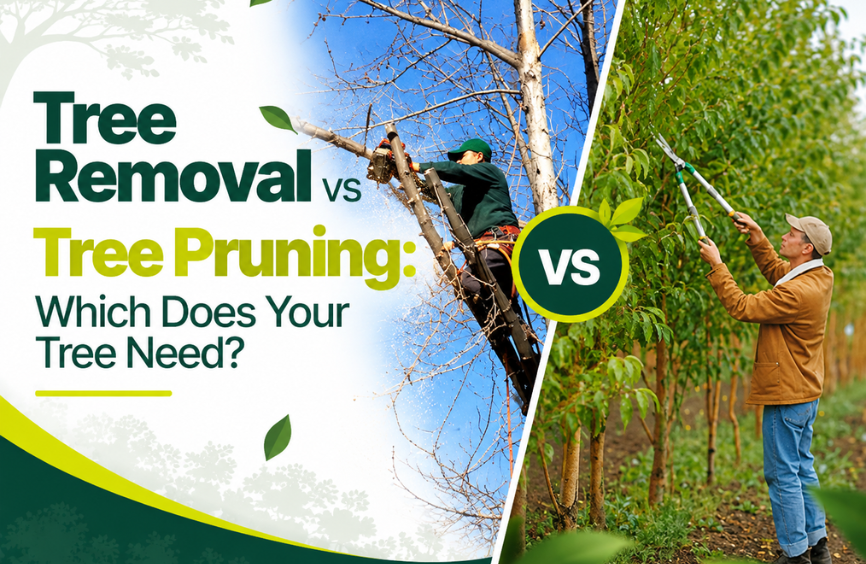
When Is Tree Removal the Better Option?
Some problems can’t be pruned away. Tree removal Rockingham properties genuinely need is warranted when:
- The tree is dead or in irreversible decline
- There’s significant trunk damage, deep cracks or a large cavity
- It has severe storm damage across the crown, not just a few limbs
- It has developed a sudden lean, which usually signals root failure
- Extensive disease or decay has taken hold through the trunk or roots
- It poses an ongoing risk to people, structures or access that pruning can’t make safe
As a rough guide, a tree that has lost more than half its crown, or has a compromised trunk, is often past saving, trimming the canopy won’t restore sound wood inside.
How Can You Tell Which Option Your Tree Needs?
Run through these before deciding:
- Is the tree generally healthy, or in decline?
- Are the problems limited to individual branches, or spread throughout?
- Is there visible decay, major trunk damage or instability?
- Is the tree affecting buildings, powerlines or access?
- Could professional pruning reasonably manage the risk?
“Healthy, localised, no major decay” points to pruning; instability, decay or structural failure point to removal. Either way, a professional look is the safest way to be sure.
Why Professional Assessment Matters
A tree can look fine from the driveway and still be hollow, or look battered yet be perfectly sound. A proper assessment weighs its structure, condition, species and location, the home, fence line, neighbours and overhead lines against WA’s storm patterns, then recommends the least invasive safe option. We won’t suggest removing a tree that pruning can reasonably fix.
Frequently Asked Questions
How do I know if a tree needs pruning or removal?
If the tree is healthy and the issues are limited to specific branches, pruning is usually enough. Major trunk damage, decay, instability or a dead tree point to removal. A professional assessment removes the guesswork.
When is the best time to prune a tree in Rockingham?
Late autumn to winter suits most deciduous trees while they’re dormant, and late winter to early spring suits evergreens and citrus. Dead, damaged or hazardous branches, though, should be dealt with whenever they appear.
Not sure which way to go? The safest step is a professional set of eyes. Get in touch with the Jordan’s Tree Services team for an honest assessment and a no-obligation quote across Rockingham and the surrounding areas.
Jordans Tree Services
Hi, my name is Jordans Tree Services. A passionate garden designer and nature lover with over 10 years of experience in landscape architecture